Special education's share of school budgets increased during and after the Great Recession. That sounds like good news: districts prioritizing their most vulnerable students.[1]
But the story is more complicated than it appears.
The Share Paradox
When we say a "share" increased, we usually imagine an active choice. Someone decided to allocate more resources to special education.
That's not what happened.
Special education's share increased not because special ed spending went up faster, but because everything else could be cut and it couldn't. When the denominator shrinks and the numerator stays constant, the ratio increases mechanically.
| Year | SpEd Spending (Indexed) | GenEd Spending (Indexed) | SpEd Share |
|---|---|---|---|
| 2008 (Pre-recession) | 100 | 100 | 16.7% |
| 2010 (ARRA) | 105 | 110 | 16.0% |
| 2012 (Post-ARRA) | 108 | 85 | 21.3% |
Indexed to 2008 = 100. Sample: 958 California unified school districts. Source: California SACS financial data.
What This Shows
Special education spending was protected. The indexed values show special ed spending increased slightly (100 → 108) while general education dropped substantially (100 → 85).
The share increase was mechanical. Special education's share rose from 16.7% to 21.3% not because of increased investment, but because the denominator (total budget) shrank while the numerator (special ed) stayed constant.
The Legal Ratchet
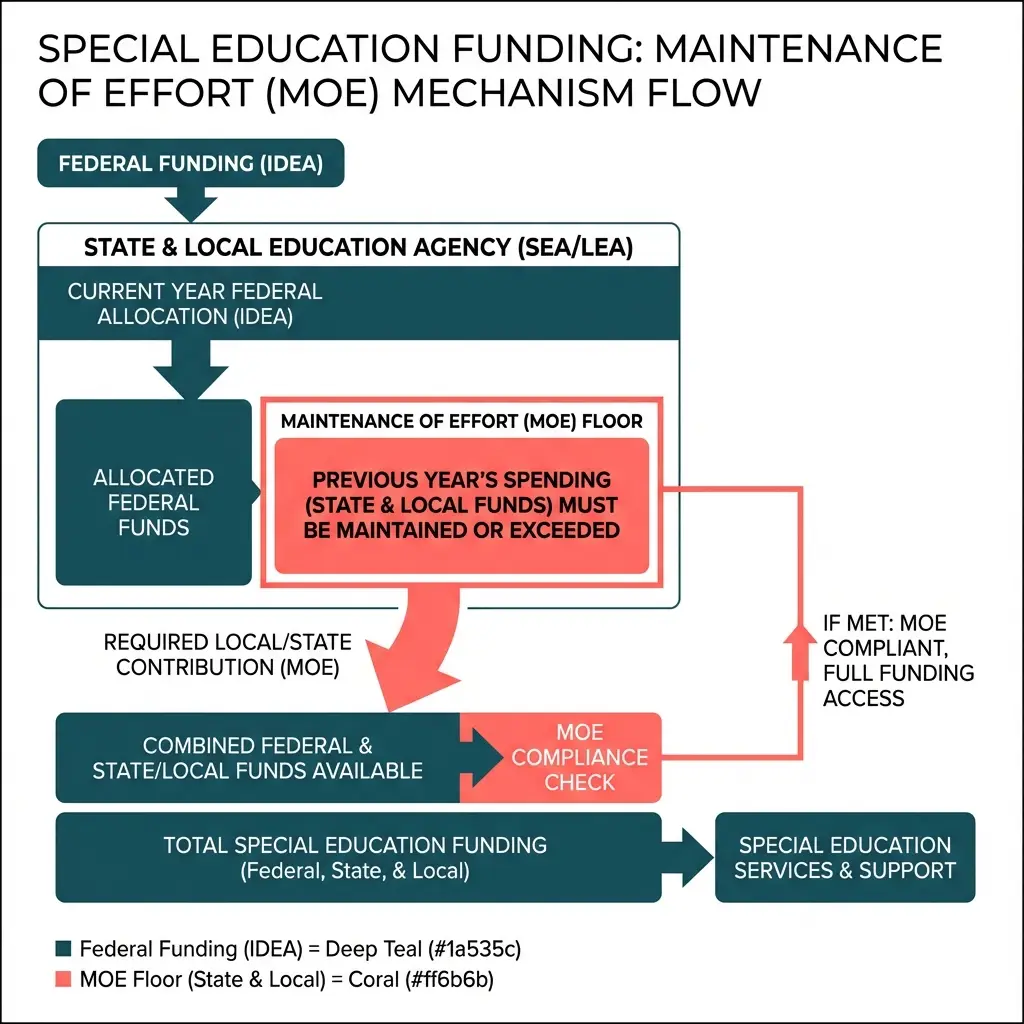
The Individuals with Disabilities Education Act (IDEA) includes "maintenance of effort" requirements. Districts must spend at least as much on special education as they did the previous year to keep receiving federal funds.[2]
This creates a ratchet: spending can go up, but it can't easily go down.
General education has no such protection. When budgets contract, districts have limited options.
Who Made This Choice?
Nobody, really. IDEA's maintenance of effort requirements are federal law. Districts don't get to decide whether to comply.
This isn't a critique of IDEA's goals. Students with disabilities deserve protected services. But we should be clear-eyed about consequences: protecting one category of spending during a budget crisis means other categories absorb more of the cuts.
The Policy Question
Should special education spending be protected during recessions? That's a value judgment, and reasonable people can disagree.
But the current system obscures the tradeoff. When we say districts "maintained" special education, it sounds like fiscal responsibility. When we acknowledge that maintenance came at the expense of general education resources, the picture looks different.
The policy choice has been made. Understanding its consequences helps us think clearly about what comes next.
Limitations
Aggregate patterns. These figures represent district-level aggregates. Individual schools and programs within districts may have experienced different patterns.
Composition effects. Special education enrollment changed during this period. Some of the spending stability may reflect changes in the student population receiving services, not just MOE requirements.
State context. California's school finance system differs from other states. The patterns described here may not generalize nationally.
Data and Methods
Data sources: California SACS financial reports (2006-2021); SACS Goal 5XXX (Special Education) expenditures; General education = Total minus special education.
Sample: 958 California unified school districts.
Calculations: All spending figures inflation-adjusted to 2012 dollars using CPI-U and indexed to 2008 = 100.
Notes
[1] National Council on Disability. (2018). Broken Promises: The Underfunding of IDEA. IDEA Report Series. https://www.ncd.gov/report/broken-promises-underfunding-idea/ ↩
[2] 20 U.S.C. § 1413(a)(2)(A). The maintenance of effort provision requires local educational agencies spend at least as much on special education as in the prior fiscal year. ↩
How to Cite This Research
Too Early To Say. "How Protecting Special Education Shifted Cuts to General Ed." December 2025. https://tooearlytosay.com/research/education-policy/protecting-special-ed-shifted-cuts/Copy citation